Silver's spot price, decoded from the ground up
What moves the silver price, how dealers build on it, and what to watch before you buy or trade.
Build a live silver price tracker today
Track live silver prices and build your own market dashboard directly from build.mithril.money.
What the silver spot price actually measures
The silver spot price is the rate at which one troy ounce of investment-grade silver changes hands right now, for immediate delivery. It is not a retail sticker price and not a futures contract. It is the live consensus of buyers and sellers on global commodity exchanges, most prominently COMEX, where the highest bid and the lowest ask meet to produce a single tradeable number.
Because that consensus shifts every second during trading hours, the spot price is a moving target, not a fixed reference. A price you see at 9 a.m. will almost certainly differ from the one at 3 p.m. That continuous movement is not noise. It is the market processing new information in real time.
The forces that push silver prices up or down
Silver's price responds to two distinct sets of pressures simultaneously, which makes it more complex to read than a purely financial asset.
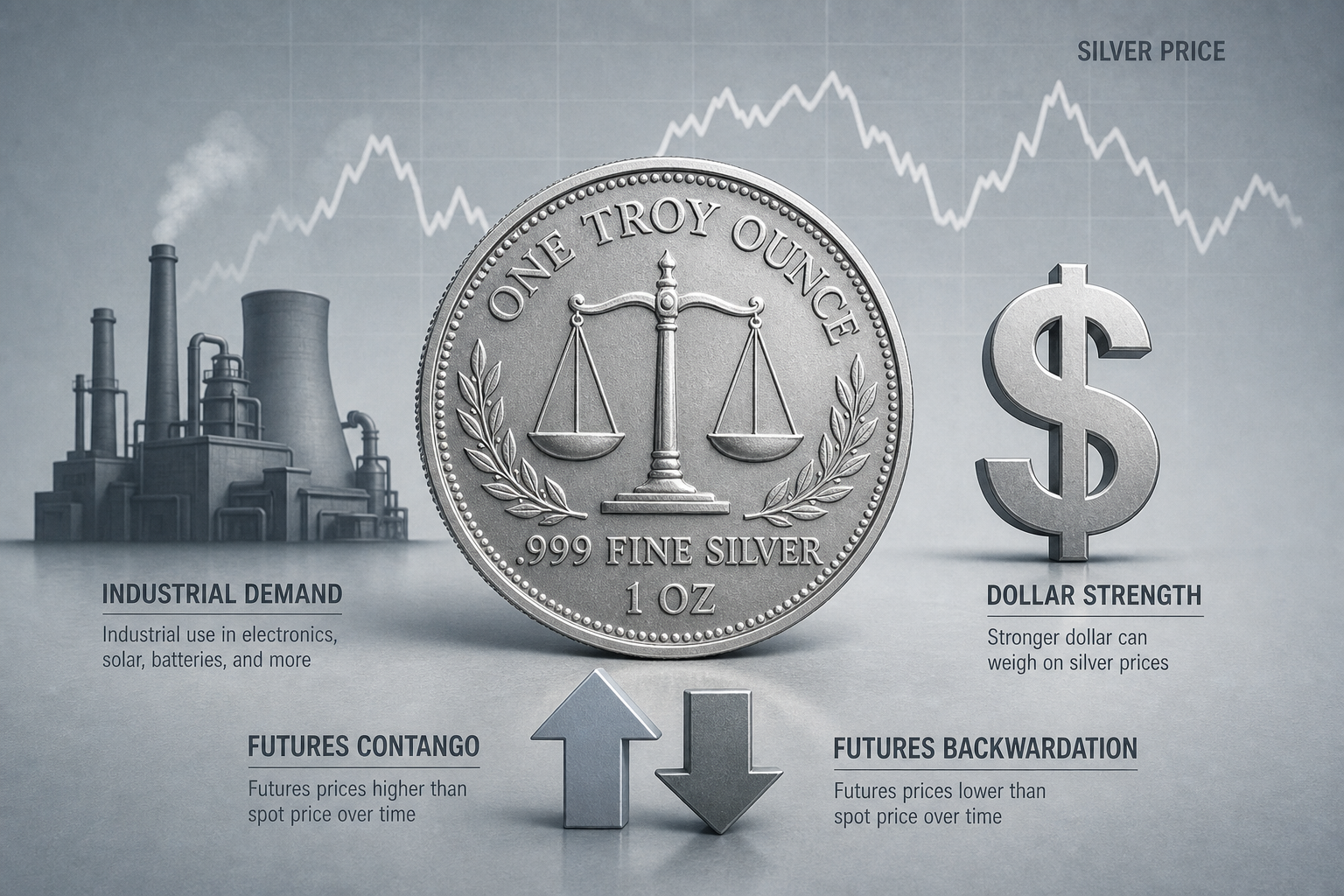
On one side sits industrial demand: silver is a critical input in electronics, solar panels, and medical equipment. When manufacturing activity accelerates, demand for physical silver rises with it. On the other side sits investment demand: traders and institutions buy silver as a hedge against inflation, currency weakness, or equity market stress. Interest rate decisions by central banks ripple through both channels at once. Geopolitical events, economic data releases, and shifts in the U.S. dollar's strength all feed into the same price in real time.
Spot price, futures price, and why the gap matters
The spot price covers today. A silver futures price covers a contract to deliver silver at a specified future date, and the two numbers are rarely identical.
When futures trade above spot, the market is in contango, which is the normal default state: buyers pay a premium to lock in future delivery. When futures trade below spot, the market flips into backwardation, a signal that demand for silver right now is outrunning available supply, or that holders want a premium to part with metal they already have in hand. Reading which state the market is in tells you something real about current supply stress, not just directional sentiment.
How dealers translate spot into a retail price
No physical silver product sells at the bare spot price. Every coin, bar, or round carries a premium above spot that covers the real costs between a raw market quote and a product in your hand: refining, minting, packaging, insurance, shipping, dealer overhead, and profit margin.
The size of that premium varies by product type. Coins typically carry higher premiums than bars because minting is more labor-intensive and collector demand adds a layer of its own. Premiums also widen when physical demand spikes and narrows when supply is plentiful. The spot price is the floor; the premium is everything stacked on top of it. Understanding both is what separates an informed buyer from one who only watches the headline number.
Tracking silver in real time, and building on that data
For anyone who wants more than a static chart, live price data changes how you can act. Mithril's API surfaces real-time market data, including tokenised equities on Solana and staking rates across networks, through a single integration. The Mithril Builder lets a trader or developer describe the tool they want in plain English and get a working, data-connected app published to their own subdomain, without wiring up separate exchange integrations.
If you are tracking silver alongside equities or other assets, that kind of unified data layer matters. The same logic that applies to equity price tracking applies here: a dashboard that updates in real time is a different tool than one that refreshes on a delay.
Silver's price answers to two masters at once: the factory floor and the trading desk, and they rarely want the same thing.
Locate the live spot price
Start with the current spot price per troy ounce, quoted in U.S. dollars on a reputable bullion or exchange data source. This is your baseline. Everything else, retail prices, premiums, futures quotes, is calculated relative to it. Check it close to when you intend to transact, not hours earlier.
Compare spot to the futures curve
Look at whether near-term silver futures are trading above or below spot. Contango (futures above spot) is the normal state and signals orderly supply. Backwardation (futures below spot) is a warning flag that physical supply may be stressed or that immediate demand is unusually strong. This single comparison adds context that the spot number alone cannot give you.
Identify the premium on physical products
If you are buying physical silver, the dealer's ask price will exceed spot by a premium. Ask what that premium covers and how it compares across dealers for the same product type. Coins carry higher premiums than bars as a rule; limited-edition or collectible products can carry premiums far above standard bullion. The premium is a real, recurring cost that affects your break-even point.
Read the macro backdrop
Check the current direction of the U.S. dollar, interest rate expectations, and any major industrial demand signals before drawing conclusions from a price move. A rising silver price driven by a weakening dollar tells a different story than one driven by a solar-panel manufacturing boom. Context separates a signal from noise.
Decide your time horizon before acting
Short-term traders care about intraday spot moves and futures positioning. Long-term holders care more about the premium paid and the macroeconomic cycle. These are genuinely different decisions. Matching your analysis to your actual time horizon prevents you from reacting to short-term volatility with a long-term position, or vice versa.
Spot price is always a live number
The silver spot price updates continuously during trading hours, meaning a quote from even an hour ago may be materially different from the current rate. Always check at the moment of decision.
Premiums are a real, variable cost
Physical silver never sells at bare spot. The premium above spot covers minting, shipping, insurance, and dealer margin, and it shifts with supply and demand conditions independently of the spot price itself.
Dual demand makes silver uniquely sensitive
Silver responds to both industrial manufacturing cycles and financial market stress simultaneously, which means a single price move can be driven by completely different forces at different times.
Futures structure reveals supply health
Whether the market is in contango or backwardation tells you more about current physical supply conditions than the spot price alone, and it is publicly visible data.
A first-time bullion buyer comparing dealers
A buyer who sees a silver spot price quoted online and then visits three dealers will find three different ask prices. The difference is not a mistake. Each dealer's premium reflects their own cost structure, product mix, and current inventory. Knowing the spot price first lets the buyer evaluate whether a given premium is within normal range for that product type, rather than accepting the first price offered.
A trader watching for backwardation signals
When silver futures flip into backwardation, a trader tracking the futures curve alongside spot gets an early signal of physical supply stress before it shows up in retail premiums. Backwardation in silver is historically uncommon, which makes it a meaningful flag when it appears. Acting on that signal requires understanding both the spot and futures market, not just one.
A developer building a multi-asset price dashboard
A builder who wants to track silver alongside equities and crypto in a single interface faces the integration problem: each data source has its own API, authentication, and rate limits. Mithril's unified data layer covers multiple asset classes through one integration, so the dashboard described in plain English becomes a working, published app rather than a months-long wiring project. Live data from day one is the practical difference.
What is the silver spot price and how is it set?
The silver spot price is the current market rate for one troy ounce of investment-grade silver for immediate delivery, quoted in U.S. dollars. It is determined on commodity futures exchanges like COMEX, where the intersection of the highest bid and the lowest ask produces the live price. It changes continuously during trading hours.
Why does physical silver cost more than the spot price?
Every physical silver product carries a premium above spot that covers the costs between a raw market quote and a finished product: refining, minting, packaging, shipping, insurance, and dealer margin. Coins typically carry higher premiums than bars because minting is more labor-intensive.
What is the difference between contango and backwardation in the silver market?
Contango means silver futures are priced above the current spot price, which is the normal market state. Backwardation means futures are priced below spot, signaling that demand for silver right now is unusually strong or that physical supply is under stress. Backwardation in silver is historically uncommon and considered a meaningful market signal.
What factors move the silver price the most?
Silver is sensitive to both industrial demand (electronics, solar, medical) and financial market conditions (inflation, interest rates, currency strength). Central bank monetary policy and U.S. dollar strength are among the most consistent drivers, but geopolitical events and economic data releases also cause sharp short-term moves.
Turn silver price data into a tool you actually own
Understanding the silver spot price is the starting point, but tracking it live alongside other assets is where real decisions get made. Mithril Builder lets you describe the price dashboard you want in plain English and get a working, data-connected app published to your own subdomain.