Beyond Coinbase: comparing crypto and financial data platforms
Fee structures, API access, altcoin depth, and data tools - what each platform actually gives you.
Connect to live markets and build your own tools
Build your own live crypto dashboard or market scanner without stitching together six different exchange integrations.
Why traders and developers look past Coinbase
Coinbase built its reputation on beginner-friendly onboarding and a strong U.S. regulatory footprint. For someone buying Bitcoin for the first time, that combination is genuinely hard to beat. But the same design choices that make it accessible create friction for anyone who wants more: higher fees on the standard consumer app (spread-based, ranging from 0.5% to 1.49% per transaction), a narrower token selection than most global exchanges, and regional restrictions on advanced features. Developers hit a harder wall: Coinbase's data access is tied to its own ecosystem, and building anything custom means working around that. These gaps are what send traders, builders, and researchers looking for alternatives to centralized exchange platforms.
The major exchange alternatives and what they each do well
Kraken is the closest U.S.-based competitor: lower base fees (0.16% maker / 0.26% taker), margin and derivatives trading, and a reputation for quality customer support. It suits experienced traders who want a regulated exchange with more firepower than Coinbase. Binance leads on breadth: the widest international token selection and low fees make it the default for altcoin traders outside the U.S. Gemini sits at the other end, prioritizing security and regulatory compliance across all 50 U.S. states; its ActiveTrader interface brings fees down, though the standard platform runs higher than Coinbase. Each of these is a full-featured centralized exchange - custody included, fiat onramps included, KYC required for most features.
Data platforms and API access: the gap most exchanges leave
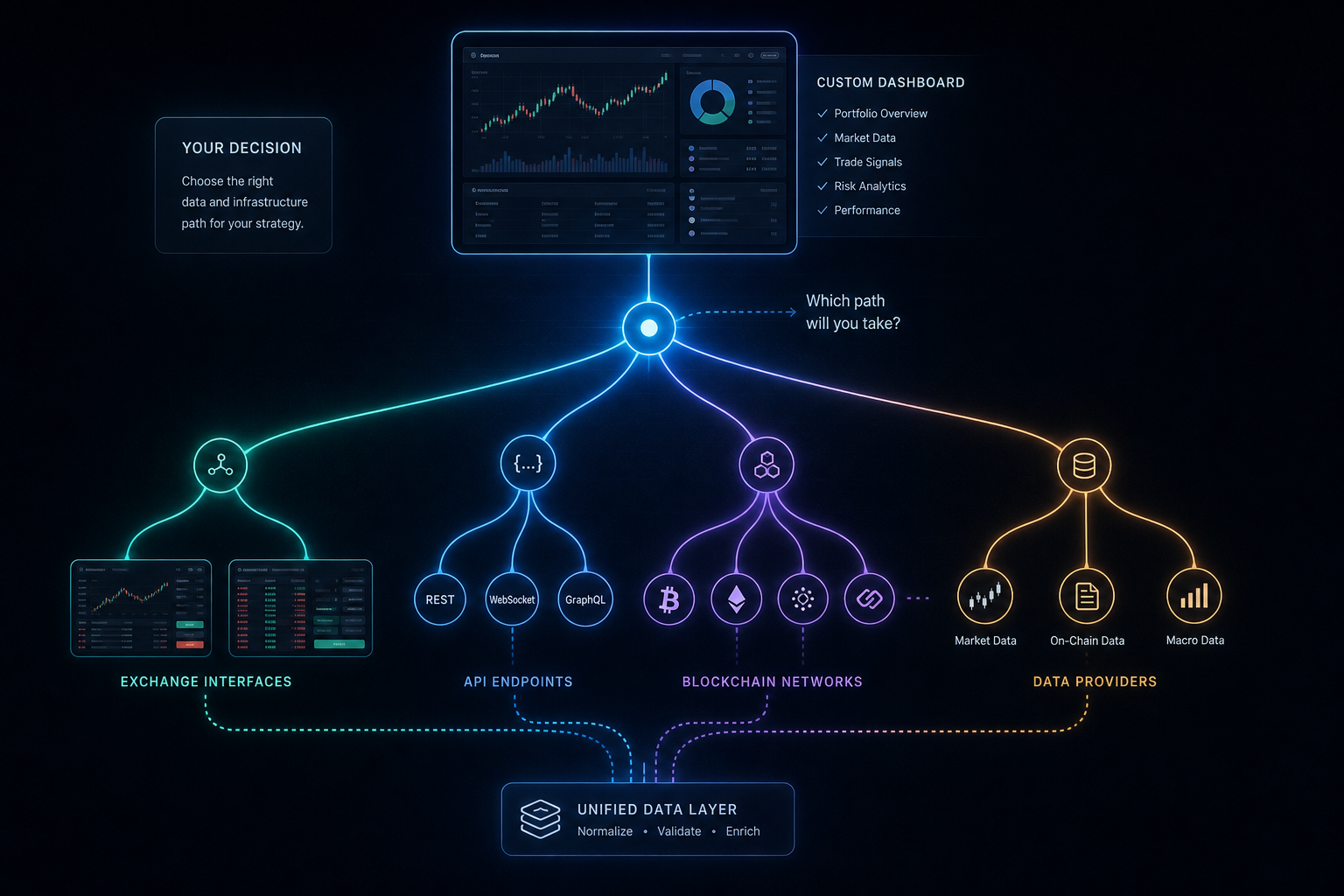
Exchanges are built to execute trades. Live price feeds, on-chain analytics, staking rate comparisons, portfolio reads across chains - these are afterthoughts on most trading platforms, bolted on rather than designed in. A developer who wants to build a portfolio tracker, a staking dashboard, or a market scanner typically ends up integrating a separate data provider, then a separate exchange API, then another for a second venue. The integration cost compounds quickly. This is the gap that dedicated financial data layers exist to fill: one connection that covers prices, history, tokenized equities, staking rates, and wallet holdings without requiring an account at every exchange you want to query. For anyone building tools rather than just using them, this distinction matters more than maker-taker fee comparisons.
Where Mithril fits in this landscape
Mithril is not a replacement for Coinbase, Kraken, or Binance if what you need is a fiat onramp or custodial storage. It occupies a different part of the stack: the data and app-building layer underneath the exchanges. The Mithril API provides public endpoints for live prices, price history, tokenized equities on Solana, staking rates across dozens of networks, and wallet holdings across chains - accessible without an account for initial exploration. The Builder lets you describe a tool in plain English and get a working, data-connected app published to your own subdomain. Users connect their own wallets or exchange keys; Mithril never holds keys or funds. For traders who want their own dashboard and developers who want one integration instead of six, it is a genuinely different kind of option. Check the live Bitcoin price feed to see the data layer in action.
Custodial versus non-custodial: a choice that shapes everything
Every centralized exchange - Coinbase, Kraken, Binance, Gemini - holds your assets on your behalf. That is convenient for fiat conversions and beginner onboarding, but it introduces counterparty risk and means the platform controls access to your funds. Non-custodial alternatives, including Mithril's approach of connecting your own wallet or exchange keys, keep that control with you. The tradeoff is real in both directions: custodial platforms offer recovery options and simpler UX; non-custodial setups require you to manage your own keys. Neither is universally better. The right choice depends on whether you are primarily storing, trading, or building - and how much you value control over convenience. Developers building tools for others almost always need the non-custodial, API-first model.
The integration cost of stitching together six exchange APIs compounds fast - which is exactly the problem a unified data layer exists to solve.
Identify what you actually need
Trading and holding digital assets is a different job from accessing live market data or building a custom tool. Centralized exchanges like Coinbase, Kraken, and Binance handle the first job well. Data platforms and app builders handle the second. Start by being honest about which category your need falls into - most frustration with Coinbase alternatives comes from applying the wrong frame.
Compare fee structures on your actual behavior
Maker-taker fees look small until you account for card deposit surcharges (routinely 2-5%), withdrawal fees, and custody charges. Gemini, for example, charges a custody fee for crypto stored on the platform, which adds up for long-term holders with diverse portfolios. Model the full cost of your actual usage pattern, not just the headline trading fee.
Check token coverage and regional availability
Binance covers the widest altcoin selection internationally; Kraken and Gemini are stronger for U.S.-regulated access. If you need a specific token or derivative, verify it is listed before committing to a platform. Regional restrictions can block features even on exchanges that are technically available in your country.
Test API access before you build on it
If you are building anything programmatic, the API matters more than the UI. Mithril's public endpoints let you query live prices, staking rates, and wallet holdings without signing up first - a meaningful advantage when you are evaluating whether the data layer fits your project. Most exchange APIs require a full account and KYC before you can test anything.
Decide on custody: your keys or theirs
Centralized exchanges hold your assets; non-custodial setups keep control with you. For pure trading convenience, custodial is simpler. For building tools, running an AI assistant connected to live markets, or avoiding counterparty risk, non-custodial and API-first is the stronger foundation. Mithril's model: users connect their own wallet or exchange keys; the platform never holds funds.
One API, multiple venues
Mithril's single integration covers several crypto exchanges and prediction markets, so an app written once works across all of them rather than requiring a separate integration per venue.
Live data without an account
Public endpoints for prices, price history, tokenized equities on Solana, staking rates, and wallet holdings mean you can build something real before signing up for anything.
Non-custodial by design
Users connect their own wallet or exchange keys. Mithril never holds keys or funds, which removes counterparty risk from the equation entirely.
AI assistant connected to live markets
The MCP server gives AI assistants around 55 tools for reading markets, checking portfolios, and placing orders through conversation, authenticated with your own key.
App builder with data built in
Mithril Builder connects to real market data from the first version of any app it generates. No placeholder numbers, no separate data wiring required after the build.
A U.S. trader wanting lower fees and more coins
A retail trader who has outgrown Coinbase's standard app and wants access to more altcoins and lower trading costs is well served by Kraken or Binance. Kraken's base rates are materially lower than Coinbase's consumer app, and its margin and derivatives tools open up strategies Coinbase does not support. This is the most common Coinbase-to-alternative migration, and the established exchanges handle it cleanly.
A developer building a portfolio tracker across chains
A developer who wants to show a user their holdings across multiple chains, priced in real time, faces a fragmented integration problem on most exchanges. Mithril's API covers wallet holdings across chains, live prices, and price history through a single integration - and public endpoints mean you can prototype before signing up. This is the scenario where Mithril's data layer beats stitching together multiple exchange APIs.
A researcher comparing staking yields across networks
Someone tracking staking rates across dozens of networks for yield comparison or a research dashboard needs structured data, not a trading interface. Mithril provides staking rate data across dozens of networks as a native endpoint. Rather than scraping individual staking dashboards or maintaining multiple integrations, a single API call returns what the researcher needs. Pair it with Robinhood financial metrics for a broader market picture.
A builder who wants a live market tool without writing an app from scratch
A trader or entrepreneur who wants a custom market scanner, a live price board, or a staking dashboard - but does not want to spend weeks on infrastructure - can describe what they want in plain English on Mithril Builder and get a working, data-connected app published to their own subdomain. The app is live from its first version because the data layer is built in, not bolted on afterward. No placeholder numbers, no separate API key hunting.
What are the main reasons traders look for Coinbase alternatives?
The most common drivers are higher fees on the standard consumer app, a narrower token selection compared to global exchanges, and regional restrictions on advanced features. Developers also find Coinbase's data access limited for building custom tools. Researched comparisons consistently identify Kraken, Binance, and OKX as the top alternatives for active traders.
Is Kraken a better choice than Coinbase for U.S. traders?
For experienced traders, Kraken's lower base fees and access to margin and derivatives trading make it a stronger option than Coinbase's consumer app. Kraken is also U.S.-based and known for quality customer support. The tradeoff is a steeper learning curve for beginners.
How does Mithril differ from a crypto exchange like Coinbase or Kraken?
Mithril is not an exchange and does not hold assets or offer fiat onramps. It is a data and app-building layer: the API provides live prices, staking rates, wallet holdings, and tokenized equity data; the Builder lets you create custom market tools in plain English. For trading and custody, a centralized exchange is still the right tool. For building on top of market data, Mithril fills the gap exchanges leave.
Can I access Mithril's market data without creating an account?
Yes. Public endpoints for prices, price history, staking rates, and wallet holdings are available without an account, so you can prototype and evaluate the data before committing. Authentication with your own key unlocks the full suite, including the MCP server's roughly 55 tools.
What hidden costs should I watch for when switching from Coinbase?
Card deposit surcharges routinely run 2-5% across most exchanges, which can dwarf headline trading fees. Gemini charges a custody fee for crypto stored on the platform, adding meaningful cost for long-term holders with diverse portfolios. Always model the full cost of your actual usage pattern, not just the maker-taker rate.
Build your own market tools on live data
If you are building a market tool, tracking staking yields, or want your AI assistant connected to live crypto data, Mithril's API and Builder are worth exploring before you wire up another exchange integration. Public endpoints are available to test right now, no account required.