AI trading bots, and where the difficulty actually is
The difficult parts of an AI trading bot are not the prediction but the plumbing around it: how stale its view of the market is, what fees do to a small edge, what happens when an order only partly fills, and how it behaves when the venue rejects it.
An AI trading bot is software that reads a market and places orders without a person clicking. This page is about building one, not about whether you should, and nothing here is investment advice.

Start from a working app
Pacifica Market Maker
a live market-making desk for Pacifica perps: set your capital and strategy, then watch spread, inventory and PnL.
Open the template
The model is the small part
Most projects spend their effort on the signal and then discover it was never the constraint. A bot with a mediocre view of the market and disciplined handling of costs and failures will usually outlast one with a clever model and naive plumbing, because the plumbing is what runs on every single order.
Every number you hold is already old
By the time your code has read a price, decided and sent an order, the book has moved. That gap is the thing to design around, not an inconvenience to ignore. A bot that assumes the price it read is the price it will get is not wrong occasionally, it is wrong in a way that costs a little every time and is invisible until you total it up.
Fees are not a rounding error on a small edge
If the difference you are acting on is a few basis points, the cost of acting is the same order of magnitude as the thing you are chasing. Any backtest that omits fees, and most do by default, will show a strategy that is profitable on paper and negative in practice. Put the real numbers in before you believe any result.
Partial fills are the normal case, not the edge case
You ask for a size and get some of it. A bot that assumes orders fill completely will drift out of the position it believes it holds, and it will keep acting on that belief. Reconcile against what the venue says you have rather than what your own code thinks it did, every cycle, not on startup.
The venue will refuse you, and that is the useful part
Rejections for size, price bands, rate limits and permissions are the feedback that keeps a bot honest. A system that treats every rejection as an error to retry will hammer the API and learn nothing. Read the reason, and treat a refusal as information about the market rather than a fault in your code.
The first thing to build
Not the strategy. Build the read side, and get it correct: a live price, the spread, the funding rate, refreshed on a schedule you understand, with an obvious signal when the data is stale or missing. Until you trust what you are seeing there is nothing to test a strategy against. The figures below this page are that read side, running now, through an endpoint that needs no key.
Live, right now, on this page
| Market | Price | Funding | 24h volume |
|---|---|---|---|
| BTC | $83,010.50 | 0.0013% | $324,939,381 |
| ETH | $2,445.05 | 0.0013% | $229,359,930 |
| SOL | $105.85 | 0.0013% | $48,055,044 |
| HYPE | $80.21 | 0.0013% | $8,753,299 |
Read from a live market as this page rendered, through a public endpoint that needs no key. Read at 2026-10-19 09:41 UTC; accurate as of that time and not afterwards.
Start from a working app
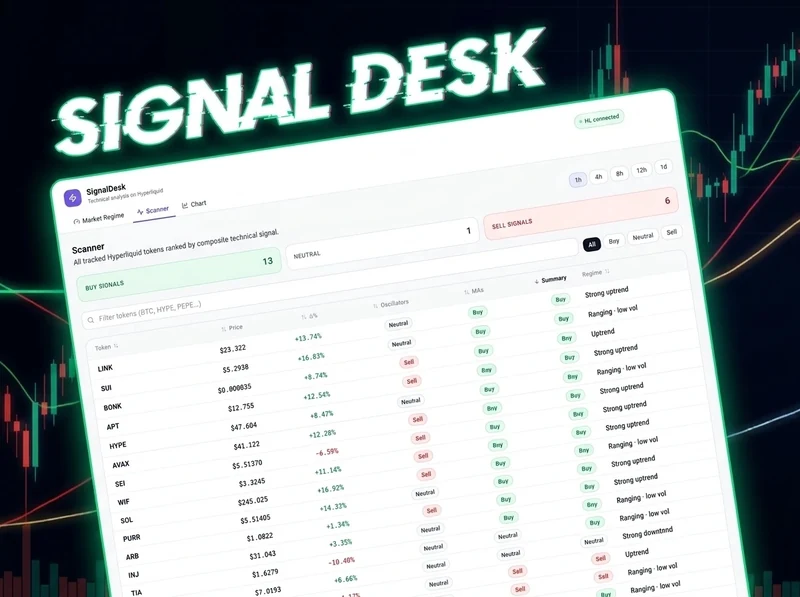
Open, change it, publish your own
SignalDesk
a multi-token scanner ranked by a composite signal, with a candle chart and technical indicators, on Hyperliquid.
Open the template
Working templates built around what this page covers. Open one, change it, and publish your own.
- Pacifica Market Maker
a live market-making desk for Pacifica perps: set your capital and strategy, then watch spread, inventory and PnL.
- Hyperliquid Market Maker
the same market-making desk on Hyperliquid perps, with spread, inventory and PnL live.
- SignalDesk
a multi-token scanner ranked by a composite signal, with a candle chart and technical indicators, on Hyperliquid.
Common questions
What is the hardest part of building an AI trading bot?
Not the prediction. It is the plumbing around it: how stale the bot's view of the market is, what fees do to a small edge, what happens when an order only partly fills, and how it behaves when the venue rejects an order.
Why do trading bot backtests look better than live results?
Most backtests leave out fees by default. If the edge you are acting on is a few basis points, the cost of acting is the same order of magnitude, so a strategy can be profitable on paper and negative in practice.
What should I build first in a trading bot?
The read side, not the strategy: a live price, the spread and the funding rate, refreshed on a schedule you understand, with an obvious signal when the data is stale or missing. Until you trust what you see there is nothing to test a strategy against.
See the number itself
Pages that read a live market and show what they read, updated while you look at them.
- Chainlink price, live, from a book that depends on oracles, mark against mid on the token that exists to publish prices, the clearest example of the difference.
- Funding rate arbitrage, live, live cross venue spreads, the kind of edge a bot is usually pointed at.
- Pacifica funding rates, live, a live rate to point an agent at before trusting it with money.
- Perp spread in basis points, live, the number that tells you whether an edge survives costs.
- Microsoft stock price, live, through the tokenised share, a tokenised share that quotes at the weekend, which is when an unattended bot is least supervised.
- Amazon stock price, live, through the tokenised share, two unrelated businesses under one ticker, which is what breaks a single signal model.
- Worldcoin price, live, and a token whose supply depends on regulators, an asset whose supply depends on regulatory notices, which no automated signal can anticipate.
Related reading
All guides · Live market pages · Components · Make Mithril a preferred source in Google