AI trading, and the distinction that matters most
AI trading is genuinely useful for building tools, dashboards, scanners, monitors and alerts, and is not reliably useful for predicting prices; the distinction matters because the first is checkable within seconds and the second cannot be evaluated until it is too late.
AI trading usually gets discussed as prediction: will this go up. That is the least promising version of the idea and the most commonly sold one.

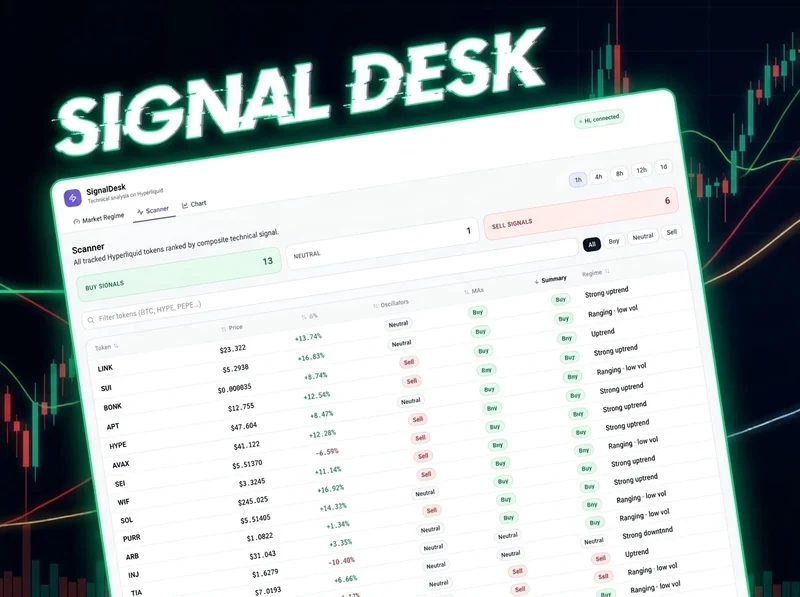
Start from a working app
SignalDesk
a multi-token scanner ranked by a composite signal, with a candle chart and technical indicators, on Hyperliquid.
Open the template
Why prediction is the weak application
Markets are adversarial and largely efficient at the timescales most people can act on. A model that finds a pattern is competing against everyone else who found it, and the pattern stops working roughly when it becomes known. That does not make prediction impossible; it makes it the hardest possible way to get value out of these tools.
The application that actually works
Building the things around the trade. A scanner that watches twenty markets you would not watch by hand. A dashboard showing your exposure in the terms you think in. An alert that fires on a condition you can describe in a sentence but would not write a script for. None of this is prediction and all of it is now an afternoon rather than a project.
Why the difference is about checkability, not difficulty
A tool is right or wrong within seconds and you can see which. A prediction cannot be evaluated until enough time has passed for it to matter, and by then you have already acted on it. Building things that can be checked immediately is a better use of a technology that is confidently wrong some of the time.
Where a model still helps with the decision
Summarising what changed, not deciding what to do. Reading a book, a funding rate and an open interest figure and stating plainly what they say is genuinely useful and entirely checkable. The moment the output becomes a recommendation rather than a description, you have moved back into the category that cannot be verified until afterwards.
Live, right now, on this page
| Market | Price | Funding | 24h volume |
|---|---|---|---|
| BTC | $82,836.50 | 0.0013% | $304,249,868 |
| ETH | $2,434.25 | 0.0013% | $218,437,186 |
| SOL | $105.80 | 0.0013% | $46,828,347 |
| HYPE | $80.05 | 0.0013% | $8,371,218 |
Read from a live market as this page rendered, through a public endpoint that needs no key. Read at 2026-10-19 07:45 UTC; accurate as of that time and not afterwards.
Start from a working app

Open, change it, publish your own
HyperBoard: Crypto Market Dashboard
prices, funding rates, open interest and liquidity across crypto perpetual markets, in three live tabs.
Open the template
Working templates built around what this page covers. Open one, change it, and publish your own.
- SignalDesk
a multi-token scanner ranked by a composite signal, with a candle chart and technical indicators, on Hyperliquid.
- HyperViz
seven live views of Hyperliquid markets, from a liquidity heatmap to liquidation zones and a funding radar.
- HyperBoard: Crypto Market Dashboard
prices, funding rates, open interest and liquidity across crypto perpetual markets, in three live tabs.
Common questions
Can AI predict crypto prices?
Not reliably. Markets are adversarial and largely efficient at the timescales most people can act on, and a pattern tends to stop working once it becomes known. Prediction is the hardest possible way to get value out of these tools.
What is AI actually good for in trading?
Building the things around the trade: a scanner that watches twenty markets, a dashboard showing your exposure in the terms you think in, an alert on a condition you can describe in a sentence. Each of those can be checked within seconds, which a prediction cannot.
Where can a model still help with a trading decision?
Summarising what changed, not deciding what to do. Stating plainly what a book, a funding rate and an open interest figure say is useful and checkable. Once the output becomes a recommendation, it cannot be verified until afterwards.
See the number itself
Pages that read a live market and show what they read, updated while you look at them.
- Circle stock price, and why it moves with interest rates, a stablecoin issuer whose revenue is the rate on its reserves.
- Robinhood stock price, and the perpetual beside it, a listed brokerage traded as a perpetual on a crypto venue.
- HYPE perp price, live, a live market to check a model's answer against.
- Bitcoin price today, the number a model will invent if it cannot read one.
- Prediction market odds, live, live odds on questions people are betting real money on.
- Google stock price, live, and what GOOGL actually is, two share classes, one contract, and a volatility number that is repricing a thesis.
- Salesforce stock, live, through the tokenised share, seat based software priced against the thing that might need fewer seats.
- Bittensor price, live, and what TAO actually pays for, a network that pays for machine learning output, so the token is the market's view of the whole arrangement.
Related reading
All guides · Live market pages · Components · Make Mithril a preferred source in Google