Backtesting, and the four ways it lies to you
In backtesting, a good-looking result is the default rather than a discovery, because four errors reliably produce one: look-ahead bias, survivorship bias, overfitting, and ignoring costs, and a result that has not been checked against all four says almost nothing about the future.
Backtesting runs a strategy against historical data to see how it would have done. It is essential and it is also the single easiest place in trading to fool yourself.

Start from a working app
Pacifica Market Maker
a live market-making desk for Pacifica perps: set your capital and strategy, then watch spread, inventory and PnL.
Open the template
Look-ahead bias
Using information the strategy could not have had at that moment. It creeps in subtly: a daily close used for an intraday decision, an index membership list as it stands today, a data point revised after the fact. It is the most common and the most flattering error, because the strategy is effectively being told the answer.
Survivorship bias
Testing against instruments that still exist. Every asset that went to zero, delisted or was quietly removed is absent from your history, so the backtest measures how a strategy did among the winners. In crypto, where the failure rate is high and delisting is common, this is enormous and largely invisible.
Overfitting
Tuning parameters until the past looks good. Any sufficiently flexible strategy can be fitted to any history, and the more you tune, the more you are describing what happened rather than what tends to happen. The tell is a strategy that degrades sharply when a parameter moves slightly: real edges are not that delicate.
Ignoring costs
Fees, spread, slippage, and the fact that your own order moves the price. A strategy trading frequently on small edges is almost always profitable before costs and unprofitable after, and the gap is widest in exactly the thin markets that show the best backtests. Modelling the spread is not a refinement, it is the difference between a result and a fantasy.
What a backtest is actually good for
Rejecting strategies, not selecting them. A strategy that fails a backtest is genuinely dead; a strategy that passes one has merely not been eliminated yet. Treating it as a filter rather than a forecast is the honest use, and it is why forward-testing on live data with real costs matters more than another decade of history.
Live, right now, on this page
| Market | Price | Funding | 24h volume |
|---|---|---|---|
| BTC | $81,739.50 | 0.0013% | $182,051,672 |
| ETH | $2,411.65 | 0.0013% | $154,275,928 |
| SOL | $103.61 | 0.0013% | $33,934,097 |
| HYPE | $78.50 | 0.0013% | $6,615,195 |
Read from a live market as this page rendered, through a public endpoint that needs no key. Read at 2026-10-18 06:12 UTC; accurate as of that time and not afterwards.
Start from a working app
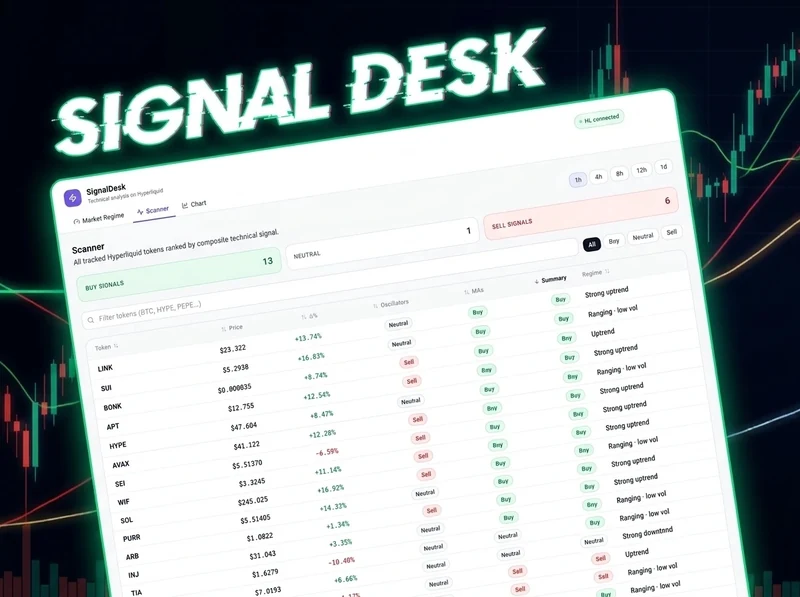
Open, change it, publish your own
SignalDesk
a multi-token scanner ranked by a composite signal, with a candle chart and technical indicators, on Hyperliquid.
Open the template
Working templates built around what this page covers. Open one, change it, and publish your own.
- Pacifica Market Maker
a live market-making desk for Pacifica perps: set your capital and strategy, then watch spread, inventory and PnL.
- SignalDesk
a multi-token scanner ranked by a composite signal, with a candle chart and technical indicators, on Hyperliquid.
Common questions
Why do backtests look better than live trading?
Four errors reliably produce a good-looking backtest: look-ahead bias, survivorship bias, overfitting, and ignoring costs. A result that has not been checked against all four says almost nothing about the future.
What is survivorship bias in a backtest?
Testing only against instruments that still exist. Assets that went to zero or were delisted are missing from the history, so the backtest measures how a strategy did among the winners. In crypto, where delisting is common, the effect is large and hard to see.
What is a backtest actually good for?
Rejecting strategies, not selecting them. A strategy that fails a backtest is dead, and one that passes has only not been eliminated yet. That is why forward-testing on live data with real costs matters more than more history.
See the number itself
Pages that read a live market and show what they read, updated while you look at them.
- S&P 500, live, as a continuously traded contract, the benchmark a strategy has to beat, quoted continuously rather than daily.
- Nvidia stock price, live, with the tape underneath it, realised volatility from hourly closes, the input a position sizer actually needs.
- Tesla stock price, live, with the week behind it, a name whose moves cluster around scheduled events, which is what breaks a naive backtest.
- Meta stock price, live, with the week's tape, a share count that shrinks through buybacks, the classic way a backtest overstates a return.
- Micron Technology stock price, live, with memory-cycle context, a commodity cycle long enough to fit entirely inside a short sample and fool it.
- SanDisk stock, live, after the split from Western Digital, a listing with almost no history, where there is nothing to backtest against yet.
- Exxon Mobil stock, live, through the tokenised share, a total return dominated by dividends, the single most common backtest error.
- Merck stock, live, through the tokenised share, a dated patent cliff, a known future step that a naive sample will not contain.
Related reading
All guides · Live market pages · Components · Make Mithril a preferred source in Google